

BEAUTY / SEPTEMBER 26, 2026 BY STACEY SAVARESE
Affiliate Disclosure: This post may contain affiliate links, including Amazon links. If you purchase through one of these links, I may earn a commission at no additional cost to you. As an Amazon Associate, I earn from qualifying purchases.
RETINOL AFTER 50
How to Start Retinol After 50 Without Overwhelming Your Skin
Most retinol guides tell you what the ingredient can do. This one shows you how to introduce it without turning your face into an unhappy science experiment.
Affiliate links · General educational information, not medical advice · Updated September 26, 2026
Retinol has somehow acquired the personality of a boot camp instructor. Use it nightly. Peel with dignity. Never admit defeat. That is not the assignment. Irritation is a side effect, not evidence that the product is earning its shelf space.
This is a slow introduction plan for an over-the-counter retinol, built around four unglamorous things that matter: a calm baseline, a low-pressure schedule, moisturizer, and sunscreen.
Retinol, Retinal, and Prescription Retinoids Are Not Identical
Retinoid is the family name for vitamin A-derived ingredients used on skin.
Retinol is an over-the-counter member of that family.
Retinal, sometimes listed as retinaldehyde, is another cosmetic form.
Prescription tretinoin, tazarotene, and trifarotene are retinoids too, but they are not interchangeable with a drugstore retinol.
The American Academy of Dermatology notes that retinol may help with uneven tone, pigmentation, texture, and mild fine lines. It also recommends beginning with the least intense formula you can find and building slowly because dryness, redness, and irritation can occur. Over-the-counter labels do not always disclose a standardized retinol percentage, so a dramatic number on the front of a bottle is not the whole story.
Important: Retinoids should not be used during pregnancy. Ask a dermatologist or other qualified clinician before starting if you are pregnant, breastfeeding, using a prescription skin treatment, managing rosacea or eczema, or dealing with persistent redness or inflammation.
THE FOUR FUNDAMENTALS
| What you need | Why it earns a place | Amazon option |
|---|---|---|
| Gentle cleanser | Removes the day without adding another source of irritation | Vanicream Gentle Facial Cleanser |
| Beginner retinol | Premeasured capsules make it easier to use a consistent amount while introducing retinol gradually | RoC Retinol Correxion Line Smoothing Night Serum Capsules |
| Plain moisturizer | Supports comfort before and after retinol nights | CeraVe Moisturizing Cream |
| Daily sunscreen | Protects skin from ultraviolet exposure every morning | Eucerin Age Defense Face Sunscreen SPF 50 |
More from Charmed Curation
Skincare Routine for Women Over 50: A Simple Morning and Night Guide →
Explore more Beauty articles →
Four Rules That Keep Retinol Boring, in the Best Way
One New Active
Do not introduce retinol, an exfoliating acid, and a mysterious peel in the same week. Your face is not a group project.
Comfort Counts
Persistent burning, cracking, swelling, or worsening redness means pause. Endurance is not a skincare goal.
Calendar Before Courage
A predictable twice-weekly start is easier to judge than applying it whenever the bottle catches your eye.
SPF Every Morning
Retinol belongs to the night shift. Broad-spectrum SPF 30 or higher takes the morning shift.
THE STARTER PLAN
Four Weeks, One Careful Introduction
1. Week One: Establish the Quiet Baseline
Before opening the retinol, spend several nights with only a gentle cleanse and moisturizer. Use sunscreen every morning. This is not wasted time. It gives you a reference point for how comfortable your skin feels without the new active.
Read the product label and test a small amount as directed before applying it broadly. If your skin is already stinging, flaky, sunburned, or recovering from a procedure, postpone the experiment. Retinol does not award attendance points.
Charmed Tip: Take one makeup-free photo in the same light. It is more useful than staring into a magnifying mirror every morning looking for overnight drama.
2. Week Two: Choose Two Nonconsecutive Nights
Choose two evenings with space between them, perhaps Monday and Thursday. Cleanse gently, let your skin settle, then apply the amount and method directed on the label. Keep it away from the eyelids, corners of the nose, and lips unless the product specifically says otherwise.
Follow with moisturizer. If your skin tends to be dry or easily irritated, you can ask your dermatologist whether applying moisturizer before the retinol, or both before and after, makes sense for you. The goal is a routine your skin can tolerate consistently, not the strongest possible evening.
Tradeoff: A richer moisturizer can feel comforting at night but too heavy on oilier areas. Use enough for comfort without turning the routine into frosting.

3. Week Three: Repeat, Do Not Escalate Automatically
If your skin feels comfortable, repeat the same two-night schedule. There is no prize for graduating early. Early irritation can show up as dryness, tightness, flaking, stinging, or redness, and darker skin tones may be more vulnerable to dark marks triggered by inflammation.
Keep scrubs, peel pads, strong exfoliating acids, and other potentially irritating actives out of those evenings. This is also a poor moment to test three samples that arrived in the mail. If your skin reacts, you want a very short suspect list.
Charmed Tip: Mild, brief dryness may settle when frequency is reduced and moisturizer is increased. Persistent burning, swelling, cracking, marked redness, a rash, or worsening pigmentation deserves a full stop and professional advice.
4. Week Four: Decide Whether Your Skin Wants More
After several comfortable weeks, some people may choose to move toward every other night, following the product directions or a dermatologist’s advice. Others stay at two or three nights a week and are perfectly happy there. Frequency is not a character test.
Judge the routine over months, not mornings. Evidence for retinoids and photoaging is built on repeated use, while cosmetic products vary greatly in formulation and stability. The sensible question is not “How fast can I use more?” It is “Can I keep using this without making my skin miserable?”
Tradeoff: A lower-frequency routine may produce slower visible change, but a product abandoned after two fiery weeks produces no long-term benefit at all.
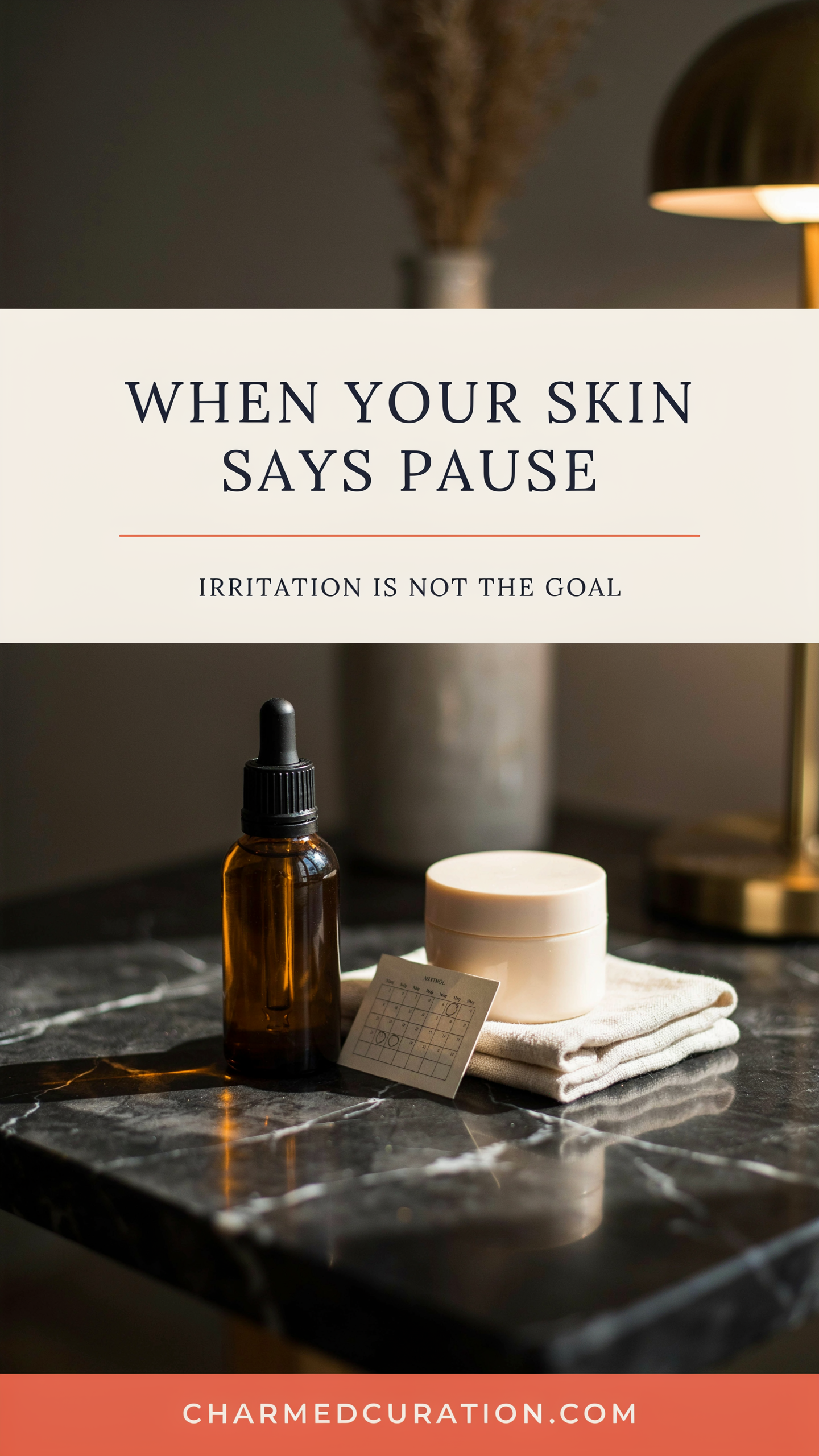
What Is Normal, and What Means Stop?
| What you notice | What to do |
|---|---|
| Mild dryness or light flaking | Pause or reduce frequency, moisturize, and restart only when comfortable. |
| Persistent stinging or burning | Stop using it and allow the skin to recover. |
| Cracking, swelling, rash, or marked redness | Stop and contact a dermatologist or qualified clinician. |
| Worsening dark marks after irritation | Stop, protect from sun, and seek professional guidance. |
| No visible change after a few weeks | Do not pile on more. Retinoid results take time, and no cosmetic promises overnight reinvention. |
The Morning Rule Retinol Cannot Negotiate
Use broad-spectrum sunscreen with SPF 30 or higher every morning, along with shade and protective clothing when appropriate. The AAD recommends sun protection while using retinoids and identifies sunscreen and moisturizer as the two foundational products in an aging-skin routine. Retinol does not replace either one.
The Eucerin option in the shopping list is fragrance-free and designed for daily facial use. Its tradeoff is that it is not water-resistant, so swimming, sweating, or a long active day outside calls for a suitable water-resistant sunscreen and label-directed reapplication.
Start With the Schedule, Not the Hype
If you begin anywhere, begin with two well-spaced nights and a moisturizer your skin already likes. Keep the rest of the routine pleasantly dull. Then give your skin enough quiet time to answer.
For the complete morning and evening foundation, read Skincare Routine for Women Over 50. Retinol is an optional chapter in that routine, not the entire book.
Leave a Reply