
ORGANIZATION / BY STACEY SAVARESE
As a Walmart Partner and Amazon Associate I earn from qualifying purchases.
SMALL WALK-IN CLOSET ORGANIZATION
Small Walk-In Closet Organization
for Clothes, Linens & More
A real-life plan for a 5-by-3-foot closet with more jobs than square footage.
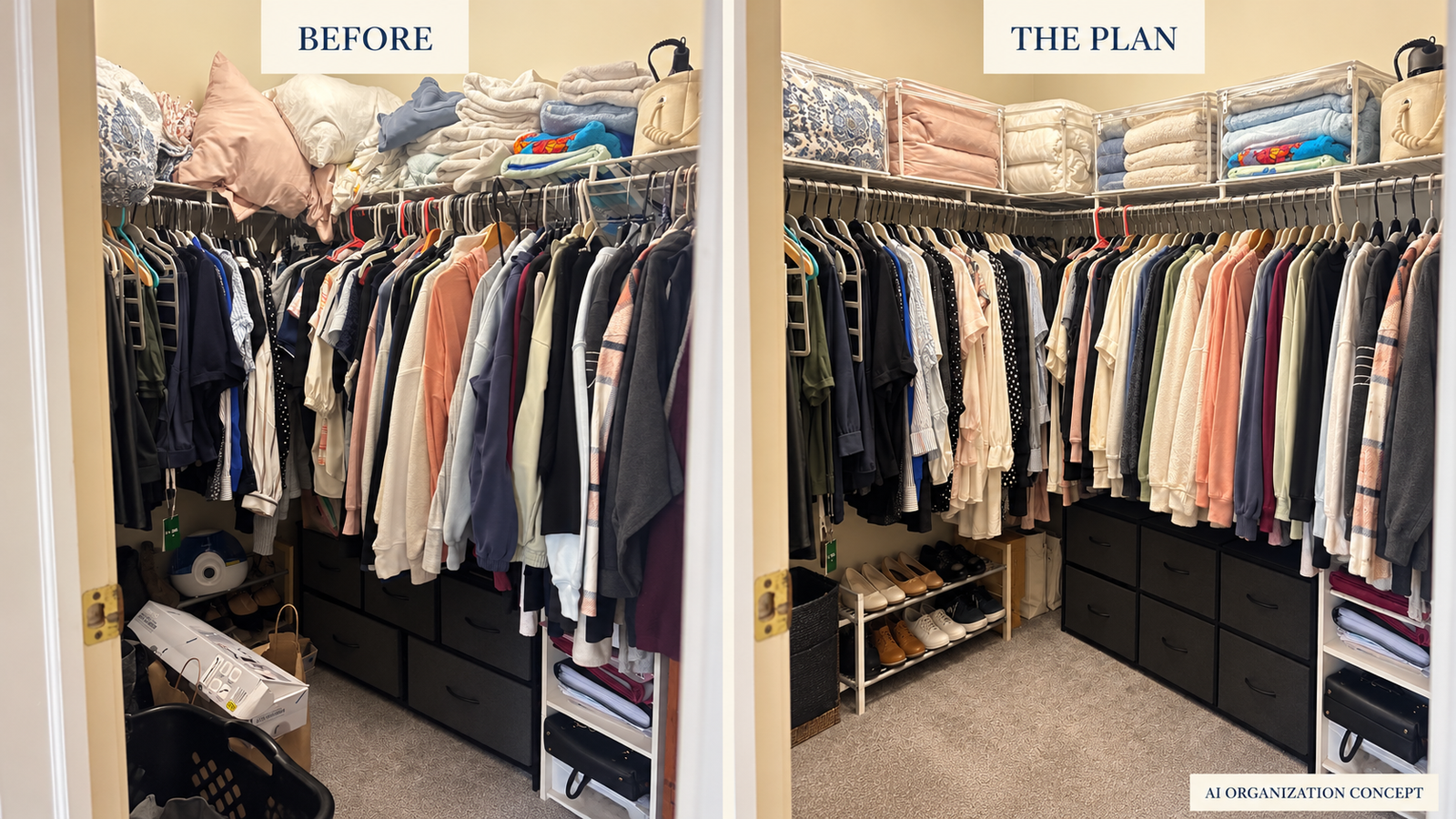
An organization plan with clearly labeled AI illustrations, not a completed makeover.
A small walk-in closet sounds like a luxury until you realize it has been assigned the jobs of a wardrobe, and a catch all for among everything including bed linens, blankets, holiday gift hiding and a temporary shipping department. Mine is about 5 by 3 feet, and the before photos tell the story: clothes fill both sides, bedding is piled overhead – usually hits me right in the head, drawers are already working hard, and the center aisle has become a narrow negotiation maze.
So this is not a fantasy makeover where everything disappears into matching baskets, and is pastel pretty.
It is my real-life plan for my itty bitty, small walk-in closet organization when the closet has to hold clothes and a mix of other household things.
I am starting with what is already here, measuring before I shop, and making the floor path the first priority…for safety reasons if nothing else!
The goal is not to own more organizers. The goal is to make every inch earn its keep without making the closet harder to use. Here are the seven decisions I am using to plan the “reset”.

One useful rule: Keep the floor path clear, use the storage already here, and let measured dimensions decide what comes home.
A small closet works better with clear boundaries
PROTECT THE AISLE
The walkway is access, not another storage shelf.
GROUP THE LINENS
Keep each sheet set together and heavy items down low.
USE THE DRAWERS
Give existing storage a clear job before adding furniture.
BUY FOR THE SPACE
Check outside dimensions, opening room and shelf compatibility.
The seven-decision closet plan
| Start here | The decision |
|---|---|
| 1 | Clear the floor |
| 2 | Measure the usable space |
| 3 | Organize the top shelf |
| 4 | Group hanging clothes |
| 5 | Use existing drawers |
| 6 | Contain household extras |
| 7 | Keep the layout safe |
Keep Reading
11 Organizing Ideas for People Who Hate Organizing
1. Empty the floor before buying a single bin
The center aisle is the most valuable real estate in this closet.
I am going to move everything temporarily into categories: clothes, bedding, bags, shoes, household supplies, and “why is this in here?”
That last category is not a moral failing. It is simply a very useful category.
Once the floor is clear, I can see the actual footprint, reach the drawers, and check what is stored at the back. I will keep a small donation bag outside the closet so decisions do not turn into a new floor pile. Yes, that has happened before in this house.
The first win is a clear path from the doorway to the back wall, not a perfectly color-coded wardrobe.
For a less overwhelming place to begin, our organizing ideas for people who hate organizing can help you choose one small task and stop there.
Charmed Tip: Move the temporary sorting piles outside the doorway so you do not organize yourself into a corner.
2. Measure the closet like a tiny room, not a shopping opportunity
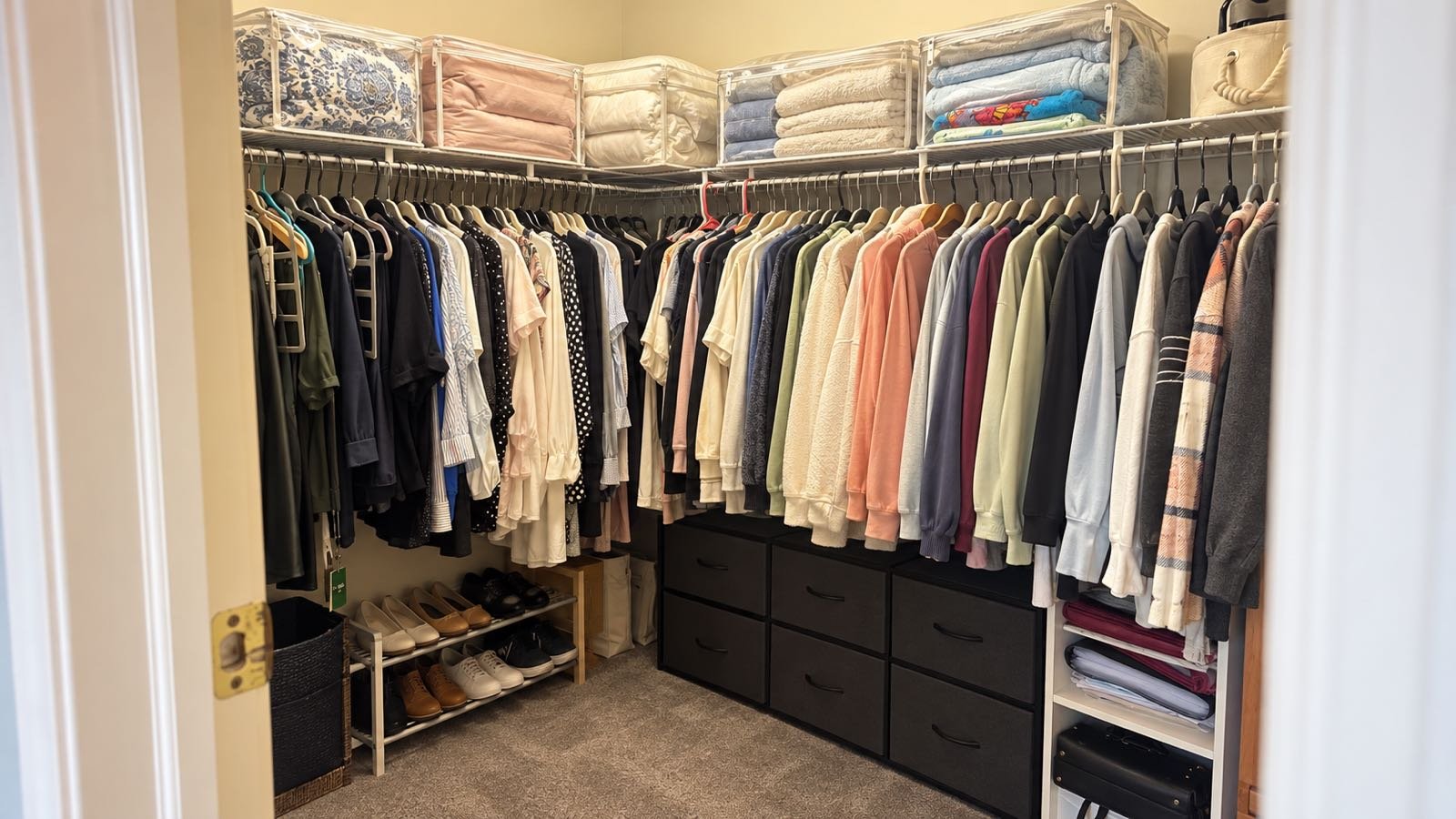
Before choosing baskets or hanging organizers, I am measuring the clear width, depth, shelf height, rod height, drawer clearance, and door swing.
A closet that measures about 5 by 3 feet gives us a useful starting point, but the usable space is smaller once the door, clothing, and existing drawers are accounted for.
I will also measure the bulky items that need a home: folded blankets, spare bedding, bags, the far right corner that has accumulated old curling irons, hair and manicuring tools. and whatever household overflow makes the final cut.
A product can be lovely, highly rated, and still be three inches too wide. That is not a storage solution; that is a return label with excellent lighting.
For a narrow closet like mine, a container that slides forward easily is often more useful than one with impressive capacity but no room to move.
Charmed Tip: Measure the opening and the room needed to pull a container out, not only the shelf it will sit on.
3. Give the top shelf one clear job
Fix, reinforce the back so it is plumb and not hanging pathetically as in the before picture.
This top shelf is currently doing a lot: pillows, blankets, hair products and other soft things are stacked together, which makes it hard to see what is there or lift one item without starting a linen avalanche.
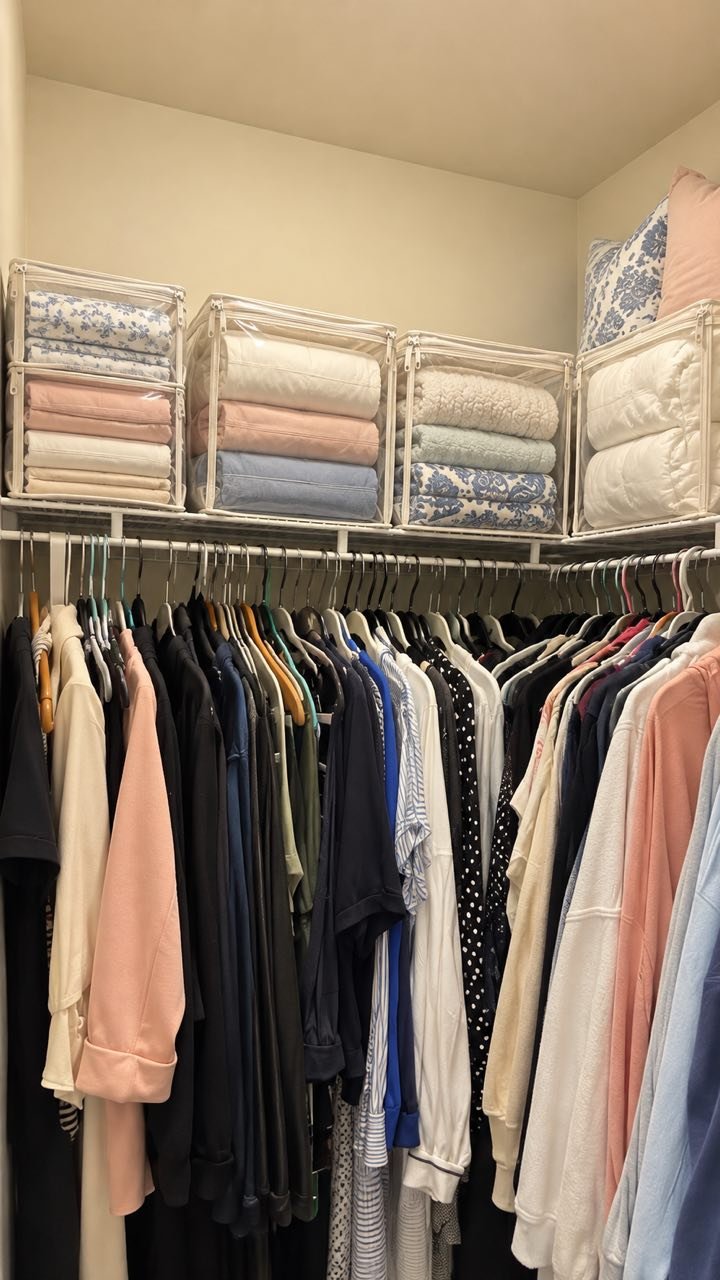
I am going to reserve this high shelf for lighter, less frequently used bedding and seasonal pieces, grouped by category.
For folded sheets and pillowcases, clear zippered storage bags could make sense: they keep small sets together, and I can see what is inside without opening every package.
For the bulkier linens, I would use a larger clear bag only if it fits the shelf and stays light enough to lift comfortably. No vacuum-packed bedding brick above my head, thank you. Not today.
If the shelf is deep enough and the dividers are compatible with its actual surface, a few clear shelf dividers could keep blanket stacks or bags from slumping into one another.
They are optional, not a requirement; on a wire shelf, I would choose a design made for wire shelving rather than assume every acrylic divider will stay put.
One bag might hold guest sheets, another pillowcases, and a divider could separate the extra blanket. The goal is to stop “bedding” from becoming one giant mystery pile.
Charmed Tip: Leave enough overhead clearance to lift one bag without pulling its neighbors down.
4. Make the hanging rods easier to read
Both sides already hold a lot of clothing, so I am not assuming that another hanging organizer is automatically the answer. First I will edit out-of-season and rarely worn pieces, then group what remains by how I actually get dressed: everyday tops, layers, dresses, and less-used items.
Matching slim hangers may help reclaim a little rod space if the current mix is bulky, but I will test a small group before replacing everything.
The closet does not need a full hanger migration program. If I add a second rod for shorter garments, I will first check hanging length, access to drawers, and whether it makes the aisle feel tighter. For now, I do like having some of the drawers at the bottom to hide out of season clothes.
I am also keeping a little breathing room between groups. Clothes that can be seen and reached are more likely to be worn; clothes compressed into one long fabric accordion are merely attending a very exclusive meeting. 🙂
Charmed Tip: Keep heavy coats on suitable sturdy hangers. A slimmer hanger is not automatically the right hanger for every garment.
5. Let the existing drawers handle folded things
The before photos show drawers already below the hanging clothes. I want to make those drawers easier to use before adding a freestanding dresser or more furniture. I will assign them simple categories such as sleepwear, workout pieces, accessories, or small household items that genuinely belong in this closet.
Small drawer dividers can help keep socks, belts, scarves, and other little things from becoming one mixed-up drawer ecosystem. I will measure the inside of each drawer before ordering anything.
A folded tee does not need a custom suite; it just needs to be findable without excavating.
Charmed Tip: Open every drawer fully before deciding that the space in front of it is available for storage.
6. Create one small home for the non-clothing mix
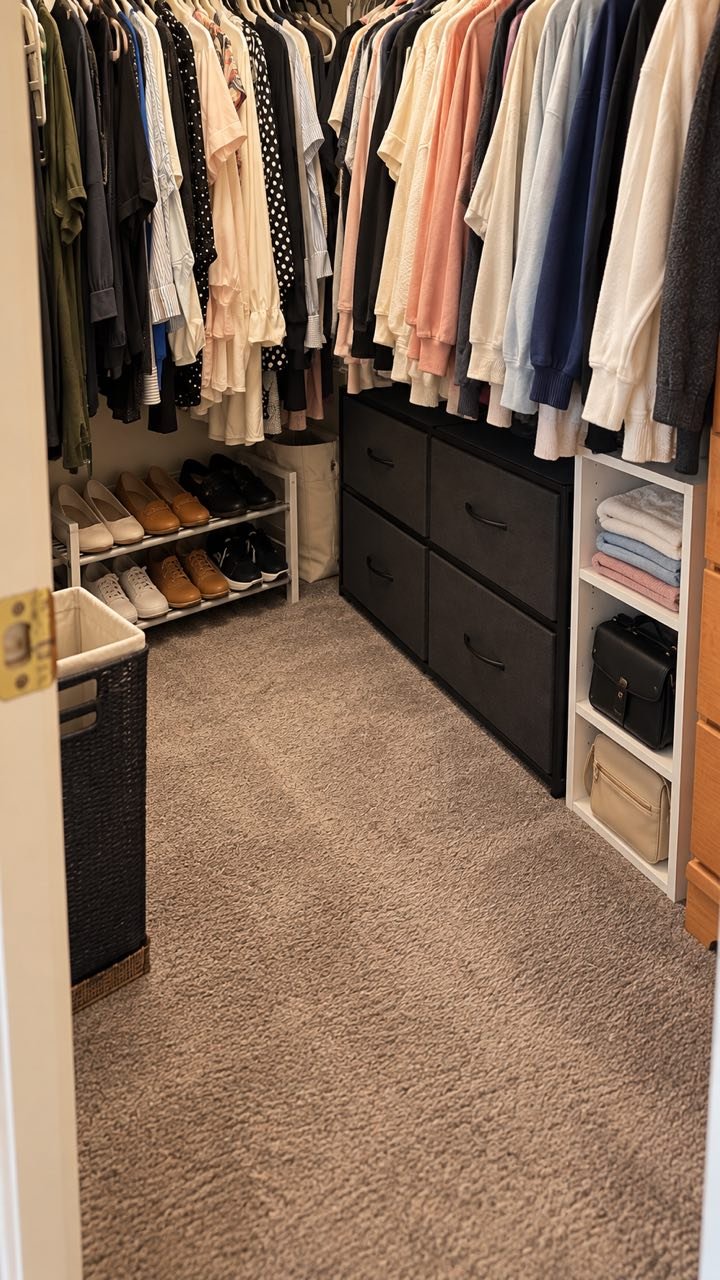
This closet has to store more than clothes, so I am giving the extras boundaries instead of pretending they will vanish. Linens can live together; bags can nest or stand in one defined spot; small household supplies can share a labeled, easy-to-reach bin. The exact mix will follow what stays after the sort.
Clear bins are useful when seeing the contents saves time.
Fabric bins can be gentler for soft items and can make an open shelf look calmer. I do not need every container to match.
I determined that I need each one to fit the shelf, slide out without a wrestling match, and have a label that still makes sense six weeks later.
For the door, I will consider a shallow over-the-door organizer only if the door closes freely and the pockets do not collide with clothes or block access. Door storage is bonus space, not permission to turn the doorway into a pocket-sized department store.
If this project inspires a few changes beyond the closet, our small home upgrades offer other practical ways to make everyday spaces feel better.
Charmed Tip: Choose a category first and a container second. A bin labeled miscellaneous is just a small closet inside the closet.
7. Keep the layout safe and easy to maintain
I want the things I reach for often between shoulder and knee height, lighter seasonal items above, and heavier supplies down low.
Any freestanding drawer unit or shelving needs to fit without narrowing the walkway. If a tall storage unit is added, I will follow its installation instructions and use the supplied anti-tip hardware where required.
The U.S. Consumer Product Safety Commission recommends securing clothing storage units to reduce tip-over risk; its guidance is especially important in homes with children. Read the CPSC Anchor It! furniture-safety guidance.
To keep the system from unraveling, I am aiming for a five-minute reset: return laundry to its zone, put bags back in their spot, and move anything that does not belong out of the closet.
No elaborate weekly ritual.
The storage plan has to work on an ordinary Tuesday when I am not feeling especially inspired by a label maker.
Charmed Tip: Keep the walking route clear and follow furniture anchoring and installation instructions.
Amazon and Walmart options for the closet plan
I would start small: one set of bags for the linens that need containing, then a small hanger swap only if the rod still feels crowded.
These are shopping options to compare with your measurements, not products I have tested in this closet.
The AI illustrations show storage categories, not exact branded products.
For the hanging rod: Amazon Basics slim velvet hangers
The Amazon Basics 50-pack of slim velvet hangers is one option for making everyday shirts and light layers more consistent on the rod. Try a few first; keep sturdy hangers for heavy outerwear and fold pieces that need different support.

#Walmart Partner
For folded linens: PLERISE clear zippered storage bags at Walmart
#Walmart Partner
Clear zippered bags could keep a guest sheet set or a group of pillowcases together without hiding what is inside. The PLERISE six-pack is a candidate to check against the actual shelf depth. Do not buy a larger pack simply because it is a pack: decide how many linen groups you genuinely need.
#Walmart Partner
For the extras: Sterilite narrow clear shelf bins at Walmart
A Sterilite narrow clear shelf bin is an option for the smaller household things that earn a place in this closet. Check its outside dimensions and the room needed to pull it forward. I would use bags for soft linens and a bin for loose small items rather than asking one container to do everything.
#Walmart Partner
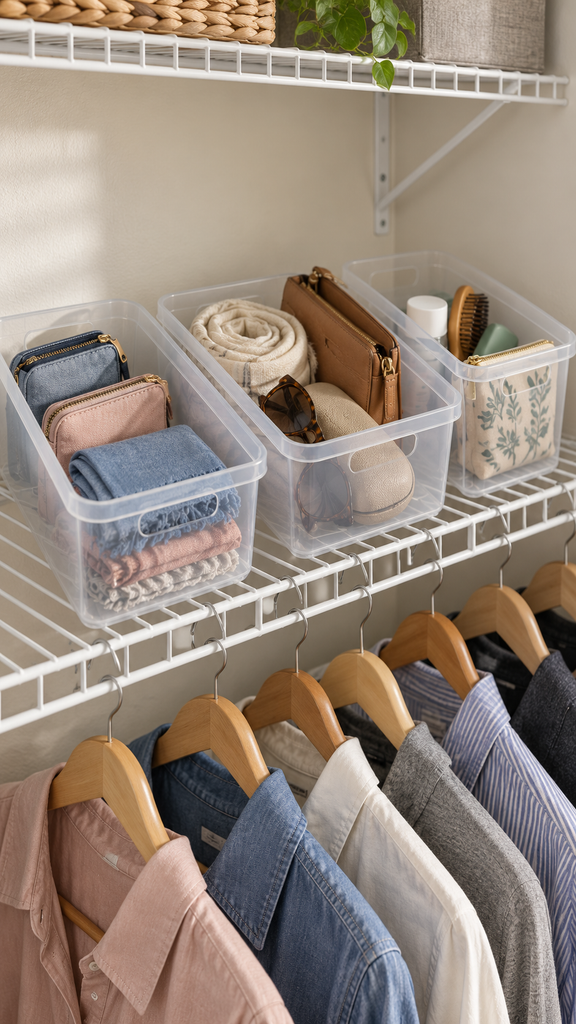
Charmed Tip: The upper shelf is wire. Do not order acrylic dividers designed only for solid shelves and assume they will stay upright here.
The real goal for this small walk-in closet
I do not need this 5-by-3-foot closet to become a boutique. I need to open the door, reach my clothes, find the extra bedding, and walk in without moving a box first.
That is a much more satisfying kind of after.
START WITH WHAT IS HERE
Clear the path. Keep the useful things.
Start with the floor, not a shopping cart. Then give each shelf and drawer one job that still makes sense on an ordinary Tuesday.
Leave a Reply